To start a war or a prolonged conflict, a provocation is often required. Sometimes local perpetrators are found, or the actions of radical individuals are skillfully exploited, as happened with the assassination of Archduke Ferdinand in Sarajevo — an attack that triggered the chain of events leading to the First World War. On the eve of the invasion of Poland, Hitler’s special services carried out “Operation Gleiwitz” — the staged seizure of a German radio station allegedly by Polish soldiers, but in reality by German saboteurs dressed in Polish uniforms.
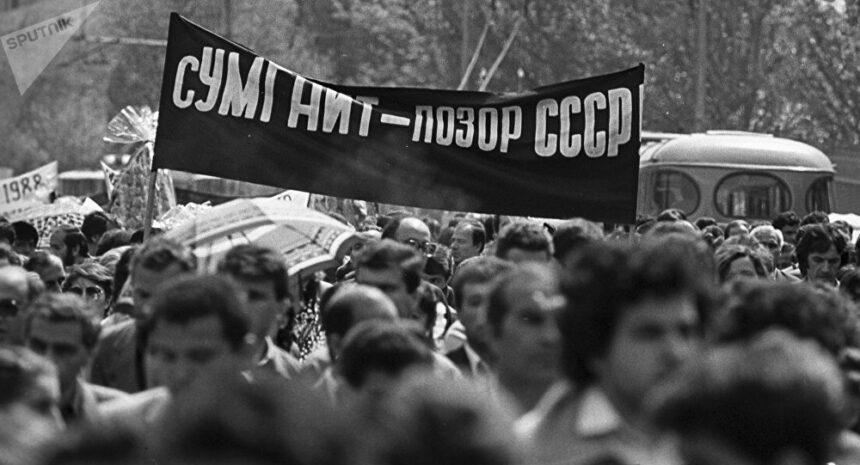
There was a similar “Operation Gleiwitz” in the history of Armenian aggression against Azerbaijan. These were the events in Sumgait on February 27–29, 1988 — a provocation organized by the Soviet KGB with active participation from Armenian nationalists. It appears that the sacrifice of Sumgait Armenians did not particularly trouble those very nationalists. The tradition of such “political sacrifice” runs deep in Armenian political culture. One need only recall the widely discussed speech of Armenia’s first president, Levon Ter-Petrosyan, before the members of the “Yerkrapah” group, in which he spoke about how Baku Armenians had been sacrificed.
According to the Armenian version, later amplified by Moscow media outlets, everything was presented in crude simplicity: cruel and bloodthirsty Azerbaijanis, given the slightest pretext, slaughtered long-suffering Armenians. Therefore, it was argued, Nagorno-Karabakh had to be urgently transferred to Armenia, otherwise Armenians there would also be massacred. However, the real facts do not fit this narrative. The history of the Sumgait provocation contains too many “oddities” that, in 1988, were ordered to be ignored.
For example, no one seriously clarified how it happened that the first ten killings in Sumgait were committed by Eduard Grigoryan, an ethnic Armenian. Moreover, according to local residents, he had been an enforcer collecting a five-percent “national tribute” — a kind of internal fundraising imposed within Armenian communities for the “common cause,” essentially a form of national racketeering. Among the victims of the supposedly “spontaneous pogrom” were Armenians in Sumgait who had refused to pay this tribute. Yet the “national tribute” version was never investigated. Nor was attention paid to reports that a certain Karina Grigoryan, who worked in emergency medical services, acted as a guide for the rioters, or that names such as Igor Oganov and a certain Vagram appeared in testimonies. These details did not fit the narrative of “evil Azerbaijanis” and “long-suffering Armenians,” and discussion of such “oddities” was effectively suppressed.
In January 1988, before any rallies in Karabakh demanding unification with Armenia had begun, dozens of Armenian families abruptly left Sumgait after withdrawing their savings from state banks. In total, 327 depositors withdrew funds exceeding 8 million Soviet rubles — an astronomical sum at the time. Such reserves were not available in Sumgait and had to be requested from Baku. This thread, too, was ordered to be forgotten.
On February 7, 1988, still in an atmosphere of apparent calm — when open conflict between Azerbaijanis and Armenians in Azerbaijan seemed unimaginable — a special group of 210 people arrived in Baku from Yerevan. They were accommodated in the city’s best hotels at the time: “Absheron,” “Azerbaijan,” “Ganjlik,” as well as in the “Bahar” hotel in Sumgait.
There are also numerous anomalies in the chronology of the events later labeled the “Sumgait pogrom.” For several days, a rally had been taking place outside the city party committee, where people simply demanded answers about what was happening in Karabakh. Then, suddenly, the situation spun out of control. The rally turned into a march. The first secretary of the Sumgait city party committee, Jangir Muslimzade, urgently recalled from leave, requested assistance from 22 military units stationed near Sumgait — but the army did not intervene. It appeared to allow events to unfold. Realizing the danger, Muslimzade personally led the column toward the seafront, away from residential areas and, crucially, from chemical plants. A punctured tank or pipeline could have resulted in hundreds, if not thousands, of casualties from a chemical disaster. Yet along the way, a “tail” broke off from the column. The rioters acted with striking professionalism. They split into groups of 10–15, moved along non-intersecting routes, bypassed apartments with Armenian nameplates on lower floors, and targeted others without visible markers — reportedly homes of Armenians who had refused to pay the tribute.
There had been no tradition of pogroms in Azerbaijani society. In Armenia, however, anti-Azerbaijani pogroms had already occurred in 1985. Many witnesses noticed camera flashes in the crowd — someone was carefully documenting events. Yet in February 1988, glasnost had not progressed to the point where such photographs would appear in newspapers the next morning. Still, the Russian-language Yerevan newspaper Kommunist quickly published an article under the striking headline “Watershed,” drawing parallels with the “Armenian genocide of 1915.” Union authorities, not to mention Armenian local officials, were in no hurry to respond to incitement of interethnic hostility.
All these “oddities” remained uninvestigated. Only after the collapse of the USSR did discussions emerge — initially in Western sources — describing the events as a large-scale, multi-layered provocation orchestrated by the Soviet KGB. Specific names were mentioned, including that of Vladimir Kryuchkov, who would later head the KGB. Subsequently, investigators such as Kalinichenko from the Union Prosecutor’s Office also spoke of a KGB provocation. But by then, the immediate narrative had already taken hold. The Kremlin had used the Sumgait events to accomplish several objectives at once.
First, the conflict needed to become irreversible. Given the Turkophobia cultivated for decades within Armenian society, it was clear how news of a pogrom against Armenians in Azerbaijan would inflame local sentiment — especially when supplemented by exaggerated or fabricated reports of “hundreds killed” and alleged “atrocities.” Azerbaijan’s international reputation suffered a severe blow. Yet Azerbaijan was one of the few Soviet republics with real prospects for economic self-sufficiency: oil, gas, a unique strategic location, and favorable positions for missile bases and radar installations.
The choice of Sumgait was deliberate. The “city of big chemistry” had long been associated with early-release prisoners sent to work in chemical industry construction — “chemistry” being the Soviet slang for such parole. Additionally, many residents of Sumgait’s informal settlements were Azerbaijanis who had fled Armenia during the 1985 pogroms. In truth, it would have been difficult to find a more suitable setting for such a provocation. The scenario unfolded with calculated precision: to ignite conflict, roll back limited reforms like glasnost, suppress the growing national movement in Azerbaijan, and once again expand Armenia — portrayed as a “Christian outpost” — at the expense of Azerbaijani lands. This reflected a policy pursued by Russian imperial strategists for centuries.
Today it is clear that this policy ultimately failed. Azerbaijan achieved independence, strengthened its position in the information sphere, and restored its territorial integrity. But this does not mean that the organizers of the Sumgait provocation should be allowed to evade responsibility.
Nurani