
Now Reading: Iran and Turkey engaged in proxy competition in the South Caucasus
-
01
Iran and Turkey engaged in proxy competition in the South Caucasus
Iran and Turkey engaged in proxy competition in the South Caucasus

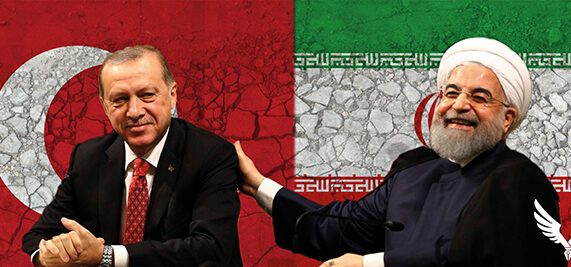
Officially, Iran does not name Turkey as a rival, but all moves made by Tehran in the past couple of months indicate the Islamic Republic’s heightening uneasiness with Turkey’s growing influence, and especially so with its alliance with Azerbaijan. Turkey has indeed substantially increased its position in the South Caucasus following the 2020 Nagorno-Karabakh War. Its drones spearheaded Azerbaijani attacks, while military intelligence proved to be as effective. Ankara also trained Azerbaijani soldiers, installed its semi-official presence in a peacekeeping monitoring mission along with Russians, and signed an official treaty of alliance, known as the “Susha Declaration”.
Moreover, for Turkey, influence in Azerbaijan is regarded as a launching pad for Ankara’s gaze toward the Caspian Sea and further into Central Asia, especially Turkmenistan. Another two countries are Kazakhstan and Uzbekistan, recently visited by the Turkish president and advancing national interests through new economic cooperation treaties. Some now see the prospect of an arc of powerful alliance of Turkic states emerging along the Middle East’s norther borders.
This unnerves the Islamic Republic which feels surrounded from the north by the Turkic arc of geopolitical influence. Since Turkey’s growing role might also be seen as benefitting the West (it is, after all, a NATO member state), this also adds another element to Iran’s discomfort. To this should be added the Turkey-Israel rapprochement and Azerbaijan opening its embassy in Israel, which creates an unofficial trilateral partnership. The effects are seen not only in diplomacy but in more practical terms too. For instance, on December 5, Turkey and Azerbaijan launched drills in several regions near Iran’s border.
The problem for Iran is further exacerbated by Azerbaijan’s increasingly coercive behavior toward Armenia. The latter, badly defeated in the 2020 war, is simply unable to resist Azerbaijan’s military power, as seen again in September. Talks on the imminent peace treaty between the two countries are underway, and this poses a real risk for Iran. Armenia may be forced to agree to the east-west “Zangezur corridor” through its southernmost province of Syunik, which could block Iran’s free movement northward. This explains Iran’s stark statements that the country would not allow any changes to the borders of the South Caucasus states.
In just one recent example, Iran’s Foreign Minister Hossein Amir-Abdollahian said in an interview that, “Iran will not permit the blockage of its connection route with Armenia, and in order to secure that objective, the Islamic Republic of Iran launched a wargame in that region.” In another move, which concealed a veiled message, Amir-Abdollahian on October 21 opened a new consulate in Kopan, the center of Armenia’s Syunik region. The geography says it all – Iran is serious about maintaining the territorial status quo in the region. Moreover, the visit pointedly coincided with Turkish president Recep Tayyip Erdogan’s trip to Azerbaijan’s Zangilan region.
The Syunik strip is effectively Iran’s only passage into the South Caucasus free of Turkic influence, thus, the geopolitical stakes are high. The loss of this connection would make Iran increasingly reliant on the goodwill of the Turko-Azerbaijani alliance, putting the two countries in a very powerful position. Such a development would probably also put paid to Iran’s hopes of building a corridor to Georgia.
Iran has upped its support for Armenia in other areas too. Both countries agreed to double the amount of natural gas the Islamic Republic provides to its northern neighbor in a deal signed during Nikol Pashinyan’s trip to Tehran. Another document signed by both parties was the MoU between the countries’ gas companies on expanding bilateral energy cooperation. Both countries also seek expansion of trade relations, which increased 43% in 2022 in comparison with 2021. The Iranian leadership, somehow ambitiously, claims that bilateral trade will reach the goal of $3 billion annually. In the first half of 2022, trade amounted to $427 million. The two sides also discussed potential Iranian engagement in the construction works in the Syunik province to facilitate transportation.
Iran is also worried about Azerbaijan’s ambitions when it comes to the integrity of the Iranian state, the northern provinces of which are populated with people of Azerbaijani descent. Divided in the early nineteenth century by invading Russian forces, the issue of ethnicity was raised repeatedly during the Soviet period and especially after the end of the Soviet Union, when the first Azerbaijani president Elchibey openly called for unification with Iran’s Azerbaijan.
The two countries have been engaged in a media war accusing each other of provocations. There even have been reports on Azerbaijani officials detaining alleged Iranian spies and provocateurs. This derailed negotiations opportunities after the announced visit of the Speaker of Iran’s parliament, Muhammad Baqir Qalibaf, to Azerbaijan was postponed, likely due to heightened tensions.
These reasons could serve as a main driver behind Iran’s massive military drills near the border with Azerbaijan. Suggestively, the Iranian army trained in how to cross the Aras River, which serves as a major dividing line between Azerbaijan and Iran. This year’s exercises follow similar drills from 2021. Both pointedly coincided with the victory date of Azerbaijan over Armenia in the Second Nagorno-Karabakh War.
Iran is thus striving to manage the emboldened Turkey-Azerbaijan axis by siding with Armenia. The geopolitical calculation is pretty straightforward from a geopolitical perspective. But Tehran is still far behind in economic and military terms when it comes to how Turkey projects its power. In this regard, Iran finds a natural partner in Russia, which likewise is worried over Turkey’s expanding ambitions in the Caucasus. Ankara’s push to seek rapprochement with Armenia, Russia’s long-time ally, military support for Georgia and Azerbaijan and forays in Central Asia, unnerve Moscow. For the latter, Turkish power projection would serve as yet another sticking point for deeper cooperation with the Islamic Republic.
What Turkey and Iran are now engaged in is essentially a proxy competition in the South Caucasus, with Iran shifting from a relatively neutral position in the Armenia-Azerbaijan struggle over Nagorno-Karabakh to an openly pro-Armenian stance, while Ankara advances its ties with Baku. This does not mean that open confrontation between the two Middle East powers is expected. Ankara and Tehran know how to deconflict from their experience in Syria and along the common border which is beset with general instability. Yet the silent competition in the South Caucasus is expected to grow further, especially as Turkey’s power grows against the still economically hobbled Islamic Regime.
Emil Avdaliani is a professor at European University and the Director of Middle East Studies at the Georgian think-tank, Geocase.

Related Posts


Previous Post
Next Post


- Aliyev says Turkic world is emerging as a major center of influence

- Baku hosts Turkic World Week honouring landmark 1926 Turkological Congress

- EU envoy holds talks in Baku ahead of high-level engagement with South Caucasus

- Europe must not lose Azerbaijan: Oleksiy Goncharenko on the risks of confrontation between Baku and the Council of Europe

- A leader forged by patience and victory
