
Now Reading: Normalisation in Caucasus depends on Azerbaijani-Turkish alliance
-
01
Normalisation in Caucasus depends on Azerbaijani-Turkish alliance
Normalisation in Caucasus depends on Azerbaijani-Turkish alliance

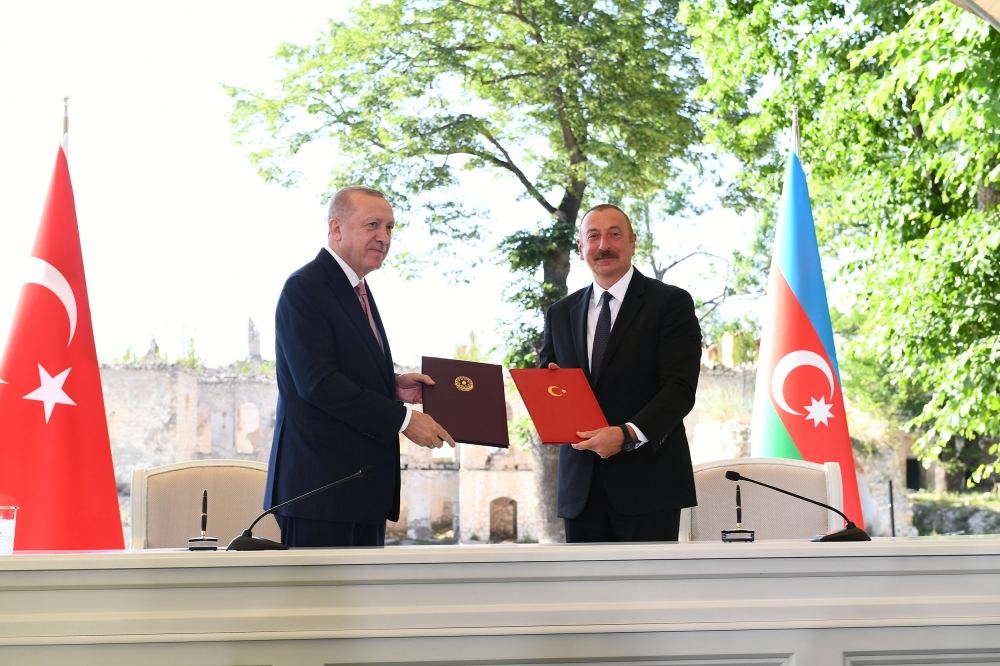
Today, Azerbaijan and Türkiye’s close ties may seem self-evident, but in fact, they are an important achievement in the foreign policy of both countries. This relationship is the result of a political choice and years of patient effort.
Erdogan stakes on Azerbaijan
Almost all key political forces in Türkiye mention the development of relations with Turkic peoples among their foreign policy goals. However, only in the case of Recep Tayyip Erdogan and his Justice and Development Party (AKP) can we say that they have made building comprehensive relations with Azerbaijan one of the central points of their foreign policy strategy.
The Western establishment and its liberal allies have condemned Erdogan and the AKP for literally every policy they pursue for decades, relentlessly predicting their failure and Erdogan’s electoral defeat. Although after winning the May 28 elections and against the backdrop of Türkiye becoming the leader in the entire Middle East, such accusations again sound completely absurd. However, more than on one occasion through these decades the situation looked different – there was even an impression that “the whole world was going to war against him”…
In this regard, it is worthy to recall the words of late Iraqi President Jalal Talabani saying in his memoirs that a politician’s life is mostly occupied by events that at first often do not look like successes, and these impressions can easily throw him off course, but with a certain persistence, they eventually lead to victory. Talabani knew what he was talking about; he spent half his life hiding in the mountains but ended up in the chair of the Iraqi state.
Erdogan is persistent in his political course, including in the direction of cooperation with Baku. He even stressed that he went after the elections to Northern Cyprus and Azerbaijan following a peculiar tradition. It is true that after the previous elections in 2018, Erdogan also made his first foreign visit to Azerbaijan. It then heralded a small but tumultuous new era that included diplomatic assistance to restore Azerbaijan’s territorial integrity in 2020 and the 2021 Shusha Declaration, which created a conceptual framework for bilateral relations.
It should be emphasised that this was the result of specific political forces invested in the development of these relations. Everything could have turned out differently and much less positively for Azerbaijan.
Kılıçdaroğlu, a candidate of the Turkish pro-Western opposition, a typical representative of the Turkish “exes” in whose hands power in Ankara was for many decades before 2003, has reminded about it again recently. Before the elections, Kılıçdaroğlu reportedly presented a scandalous strategic plan for regional communications development according to which Türkiye was to build a road to China bypassing Azerbaijan via Iran and Zangazur corridor was to be discarded as useless.
The Future, not the Past
One of the strangest accusations against the AKP has always been that it adopted a kind of neo-Ottoman ideology. The label seems to have been slipped by foreign pop political analysts, for whom Türkiye has always been but a reincarnation of the Ottoman Empire, much as Russia was a reincarnation of the USSR.
Nikolai Silayev, a senior fellow at the Centre for Caucasian Problems at the Moscow State Institute of International Relations, describes Erdogan’s Turkish foreign policy in the following way in the Moscow Vedomosti: “For years he has been addressing the Ottoman heritage in one form or another: either with an emphasis on Islam, or on territories that used to be part of the Ottoman Empire”.
But in fact, the AKP has managed all these years to conduct a successful and innovative foreign policy – knowing, however, the measure and not taking it to adventurism. In the West, they like to talk about neo-Ottomanism in order to hint at its anachronism, archaicness and absurdity. But it would be much more appropriate to speak of Türkiye’s serious “soft power” abroad, transport and logistics projects or the concept of a “blue homeland,” which directed Türkiye’s foreign policy toward protecting its interests in the seas.
Similarly, the attention of the Turkish government over the past two decades to the South Caucasus does not stem from some Ottoman past but is the result of a rational reflection on the material and immaterial needs and interests of the Republic of Türkiye.
Generally speaking, for the Ottoman Empire, the Caucasus was a distant frontier, which began to be dealt with when there was a threat to the power spread over three (!) continents – for example, a threat from Iran or Russia. In all other respects for the Ottoman State, even tiny Crimea was many times more important than the whole Caucasus, both the South and the North. Therefore, a specific Ottoman tradition could not move Erdogan to develop relations with Azerbaijan and launch a new course towards the South Caucasus due to the absence of such a tradition.
Moreover, it can hardly be said that the AKP politicians inherited that course from the previous Turkish governments of the 1990s and earlier. They did say a lot of rhetoric and make grand gestures toward the independent states, the Turkic republics of the former Soviet Union. But the current sustainable ties were only secured by years of efforts by businesses and charities associated with the AKP and then Erdogan’s new course.
The latter, once again facing the EU’s racist attitude to Türkiye’s accession in the early 2000s, has made a reasonable conclusion that the EU and the West are not the only things on earth, there are other directions, and above all the neighbouring South Caucasus and Azerbaijan.
Interestingly, the supporters of the Turkish opposition during the recent presidential campaign in Türkiye accused Azerbaijani President Aliyev of allegedly supporting Erdogan, driven by his friendly relations with the Turkish leadership. And here the most interesting thing is not even the real facts and whether there is something reprehensible in these facts (although we are talking about the quite logical positive attitude of the Azerbaijani side to the forces in Türkiye, which have long proved their friendly attitude to Azerbaijan). Here we are more interested in the attitude of pro-Western liberal Turkish elites toward relations with Azerbaijan. After all, observing this picture, there is a strong impression that if they came to power, they would not hesitate to reconsider relations with Azerbaijan.
Reconstruction of the Caucasus: From sea to sea
Erdogan’s trip to Northern Cyprus and Azerbaijan on June 12-13 is thus by no means accidental. These are not rituals (although what is there without them in our lives?), but rather indicators of what has been achieved and signposts of Türkiye’s future foreign policy course.
The talks in Baku focused on bilateral relations and the situation in the South Caucasus. As emphasised by Turkish experts, Erdogan was accompanied by the Ministers of Transport and Energy during his visit to Azerbaijan, which indicates certain intentions. Indeed, transport and communication issues were mentioned particularly frequently in the talks.
The presidents discussed not only the Zangazur corridor but also an even larger-scale project – the “Middle Corridor” across the Caspian Sea (Trans-Caspian International Transport Route – TTIM) and the Baku-Tbilisi-Kars railroad associated with it. In fact, the discussions implicate the development of an overland (primarily railway) route between China and Europe bypassing Russia through Central Asia, Azerbaijan and Türkiye.
As former Kazakh diplomat Nikolai Kuzmin ironically noted recently in this regard, the West has talked a lot about such a project and even seemingly allocated money for it, but “let’s remember the TRACECA project (transport corridor Europe – the Caucasus – Asia), which largely coincides with the Middle Corridor, which was launched under the auspices of the European Union 30 years ago. What was built in the end? It was what the Europeans know how to build well – a powerful bureaucratic structure.”
Transportation projects largely require the normalisation of relations in the region, in particular the stabilisation of recognised borders and an end to revisionism. In this regard, the decision of the Turkish side to open a consulate general in the liberated Shusha should be considered, and as the Turkish leader stressed, “this will naturally send a separate message to the whole world, including Armenia, again.”
At the same time, on June 13, some newspapers wrote that during Armenian Prime Minister Pashinyan’s secret talks in Ankara during his recent trip to Erdogan’s inauguration, the possibility of opening the Armenian-Turkish border as early as the second half of July was discussed.
However, the normalisation of the South Caucasus faces obstacles not only in the form of Yerevan’s red tape and this has been thoroughly discussed by the leaders of Azerbaijan and Türkiye. On his return from Baku Erdogan stated that the problems connected with the creation of the “Zangazur corridor” are linked to the stance of Iran, and this upsets both Azerbaijan and Türkiye. At the same time, the Turkish leader noted that it would be more profitable for Iran itself to reconsider its attitude towards the project (and establishment of communications between China and Europe) and therefore there is a hope that the problem will be resolved.
This promises great opportunities for all countries: “If they approached this positively, today Türkiye – Azerbaijan – Iran would be integrated with each other both by road and rail, and perhaps the Beijing – London line would be opened as well.”
But so far the situation remains tense, and so the talks in Baku touched on defence and military-technical cooperation. The presidents opened a new Central Command Post of the Azerbaijani Air Force in Baku. Aliyev reminded his counterpart that after the war in 2020 it was decided to develop the Azerbaijani army according to the Turkish model, and “we see it with our own eyes today. The choice of the Turkish model is clear – the Turkish army is considered an effective and serious force even within NATO. The Baku meeting resulted in the announcement of plans to hold 16 joint Azerbaijani-Turkish military drills this year, of which six have already taken place. For comparison, according to the Turkish government, 12 joint military drills with Azerbaijan were held in 2022.
The reaction of Azerbaijan’s northern neighbours to the latest events is curious. Some Russian media outlets stated that by visiting Azerbaijan “Erdogan confirmed his bellicosity.” Others saw the main purpose of Erdogan’s visit as “coordination of joint policy in relations with Armenia and Russia.”
From their point of view, this is bad, because “strengthening of relations between Baku and Ankara is not in the interests of Moscow”, as they say, Russia cannot build “equal relations” with Azerbaijan, because Ankara was ahead of them – “the Azerbaijani-Turkish tandem was formed in the early 1990s”.
Virtually everything here is a set of propaganda clichés, rather than a calm attitude to the aspirations of neighbouring countries to build a better future, and to the fact that a better future is not limited only to cooperation with the Kremlin. Yes, but what prevented Moscow from building a similar relationship with Baku? Maybe it would be worthwhile to ask themselves this question and critically analyse their own actions. For example, like Erdogan and the AKP in the early 2000s?
Without mysticism and lyrics
The Azerbaijani-Turkish alliance did not come “out of nowhere”. Its creation, patient development and preservation are not the result of some mystical forces or historical inevitability. It is important to remember that the common past, the proximity of culture, language and geographical proximity only create preconditions for rapprochement, but do not guarantee it.
An example of that is the bitter and bloody present of the three Eastern Slavic nations, which hardly anyone could have foreseen ten years ago – when the governments of all three countries almost created the Customs Union (now the EAEU).
The development of events after that time once again clearly showed that there is hardly anything absolutely inevitable in history at all, and if you do not take care of your own interests, the imperialist powers and blocs will quickly tear apart even fraternal ties. Another example is the long-standing enmity between even neighbouring Arab countries like Syria and Iraq and the many so-called civil wars organised by imperialist actors even in ethnically homogeneous countries.
So, speaking of Azerbaijani-Turkish relations, it is worth bearing in mind that they are the result of specific efforts of specific politicians and structures. A detailed analysis of the history of their development shows that they were started by Heydar Aliyev, and built by the current leaders of Azerbaijan and Türkiye and the forces behind them.
And these relations do not develop by themselves but require further efforts to maintain and develop them. The development is according to the requirements of the time, rather than ideological projects or dreams about recreating something great and ancient (which often never existed).
All that has been achieved in the past two decades is the result of following the requirements of the time and the interests of modern Azerbaijan and Türkiye. An alternative approach would lead to a dead end similar to the one in which some Eastern European countries, and even neighbouring Armenia, have already found themselves.
Serhey Bohdan
Caliber.Az
Related Posts


- Aliyev says Turkic world is emerging as a major center of influence

- Baku hosts Turkic World Week honouring landmark 1926 Turkological Congress

- EU envoy holds talks in Baku ahead of high-level engagement with South Caucasus

- Europe must not lose Azerbaijan: Oleksiy Goncharenko on the risks of confrontation between Baku and the Council of Europe

- A leader forged by patience and victory
