
Now Reading: The ‘Kocharyan problem’ can be solved in one step
-
01
The ‘Kocharyan problem’ can be solved in one step
The ‘Kocharyan problem’ can be solved in one step

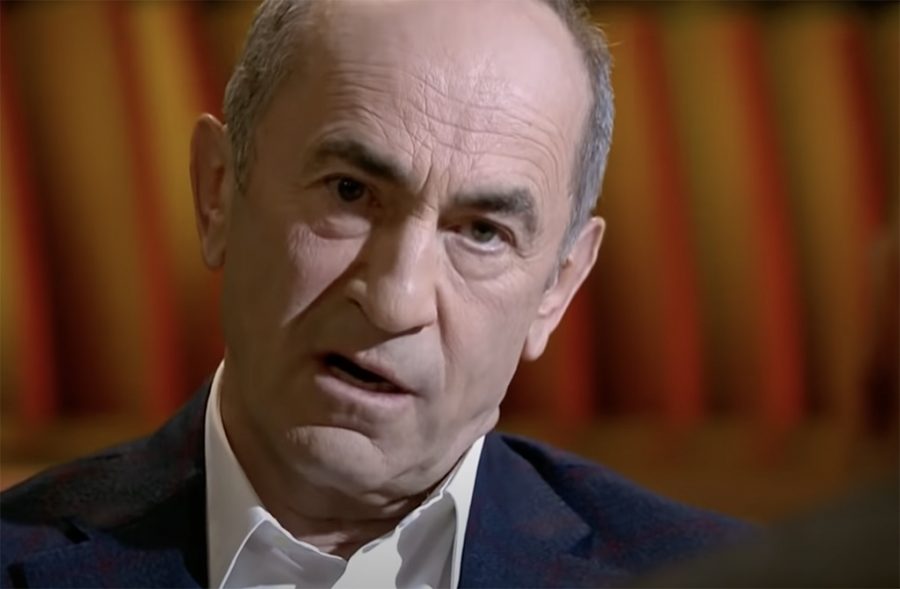
In the camp of Armenian revanchists there is a serious revival with a distinct smell of mothballs. Robert Kocharyan — the second president of Armenia and, at the same time, a war criminal — held his press conference. Of course, Robert Sedrakovich did not elaborate during his conversation with journalists on the circumstances of the genocide of Azerbaijanis in Khojaly. He had enough other things to talk about.
Firstly, as Kocharyan assured, he participated in the negotiations until 2008, and the words “Alma-Ata agreements” were never mentioned. The point, let us recall, is about the Alma-Ata Declaration, where the borders of the union republics that existed at the moment of the collapse of the USSR were recognized as state borders. According to this declaration, Karabakh is part of Azerbaijan. Simply put, Robert Kocharyan is not just accusing Pashinyan of “retreating” in negotiations — it is a serious statement that, in the event of the opposition’s victory in the elections, Armenia’s recognition of the Alma-Ata Declaration and the territorial integrity of Azerbaijan could be revoked.
Robert Sedrakovich did not stop there. He added: “During the years of my rule we had a significant advantage in combat readiness compared with Azerbaijan, therefore talk about the violation of the military balance in my time is groundless.”
Here, of course, the second president of Armenia would not find it useless to get acquainted with the speech of the president of Azerbaijan Ilham Aliyev at the Council of CIS Heads of State in December 2020. As the head of state then noted: “Those who are now trying in Armenia to use the situation for their political purposes and attack Nikol Pashinyan must understand that it was not his army, he would not have had time to create it. And yes, maybe he did not manage to do what was necessary, but for almost 20 years that army was created by Kocharyan and Sargsyan. And we crushed their army.”
So with the topic of “military superiority” Kocharyan should be more careful. Even if he is very strongly hypnotized by the memory of territorial seizures of the early nineties. To prepare for the war before last is not the smartest step.
But it is exactly this idea that Kocharyan persistently tries to sell at least to part of the Armenian audience. At the same time he does not directly promise to revoke the recognition of borders or to achieve military superiority over Azerbaijan, but he makes quite transparent hints. Knowing the tendency of the Armenian political beau monde, or at least a significant part of it, to “hear” not what is said but what one really wants to hear, the idea of “Kocharyan will come and return Artsakh” will, at least among a certain part of the Armenian audience, gain popularity.
But there is one more circumstance here. Nikol Pashinyan, the former leader of the “barbecue revolution,” is a politician in every sense public, an idol of the street. Kocharyan, unlike him, is not a lover of rally shouting. He is a conspirator who, for the sake of coming to power, will use both intrigues, and political murders, and terror. There are as many examples and proofs as you wish — from the murder of Artur Mkrtchyan in Khankendi, after which power in Karabakh was finally seized by Kocharyan, to the very piquant circumstances of the “creeping coup” in Armenia in 1998, which was accompanied by a series of political murders, and the “parliamentary terrorist act” of October 27, 1999, when, among others, the most dangerous opponents of Kocharyan — Karen Demirchyan and Vazgen Sargsyan — were killed.
About this, at his press conference, Kocharyan, naturally, kept silent. But he already announced the time frame: in his opinion, it is necessary to carry out Pashinyan’s impeachment before the end of 2025. And it is not hard to guess that in the entourage of such a person as Kocharyan, other options are also being considered.
Whether with their help Kocharyan will be able to come to power, whether the agreements reached in Prague and in Washington will be questioned, whether the peace process will be continued or Armenia will again turn toward confrontation — all this so far are very hypothetical questions. But what is beyond doubt is that for Armenia itself a turn toward confrontation will turn out to be a collective national suicide.
All the more obvious is that Robert Kocharyan — experienced, cynical, stopping at nothing — can create serious problems for Nikol Pashinyan, and not only on the electoral field. Especially if the second president of Armenia manages to enlist the support of external players, and this, at least, cannot be excluded.
At the same time, let us recall once again, Robert Kocharyan has been declared in Azerbaijan on international wanted list as a war criminal. And the “Kocharyan problem” Pashinyan can solve simply — to hand him over for trial to our country. Moreover, a lasting peace in the region is hardly possible without bringing to justice war criminals and instigators of war. It must begin precisely with such steps. Bringing Kocharyan to trial in Baku today is in the interests of everyone, including Armenia itself. The question is how well this is understood in Yerevan.
Nurani
Translated from minval.az
Related Posts


Previous Post
Next Post


- Aliyev says Turkic world is emerging as a major center of influence

- Baku hosts Turkic World Week honouring landmark 1926 Turkological Congress

- EU envoy holds talks in Baku ahead of high-level engagement with South Caucasus

- Europe must not lose Azerbaijan: Oleksiy Goncharenko on the risks of confrontation between Baku and the Council of Europe

- A leader forged by patience and victory
