
Now Reading: The Turkic-Tajik confrontation: a struggle between nomadic and sedentary peoples
-
01
The Turkic-Tajik confrontation: a struggle between nomadic and sedentary peoples
The Turkic-Tajik confrontation: a struggle between nomadic and sedentary peoples


Introduction
According to a legend, the famous Persian poet Ferdowsi devoted 30 years of his life to his Shahnameh and, having finally completed it, sent his work to the Turkish Sultan Mahmud Ghaznavi. Sultan Mahmud, who favored poetry and the arts, gave poets and scholars a large amount of money each year from his treasury, supporting them financially. Sultan Mahmud also promised Ferdowsi to give him a gold piece for each couplet he wrote. Based on this, Ferdowsi expected to get 60,000 gold pieces from the Sultan for his poem. According to one version, Sultan Mahmud, who did not like the Shahnameh, sent Ferdowsi silver instead of gold. After this incident, Ferdowsi wrote a scathing satire against the sultan and had to leave his home country and live his life abroad until his old age.
Although this legend means little in itself, it plays an important role in the context of understanding the Iran-Turan conflict from a historical viewpoint: a sedentary Tajik poet complaining about the nomadic Turk ruling over him. Ferdowsi devoted a large part of his Shahnameh to the Iran-Turan wars as it was. Rustam Zal, fighting against the attacks of the Shah of Turan Afrasiab (Alp Er Tunga according to Mahmud al-Kashgari) on Iranian lands, and the struggle of the Iranian people against the Turanians are the cornerstone of Ferdowsi’s Shahnameh.
One point should be stressed here. What Ferdowsi says about the Turks does not mean that he was an ethnic nationalist or a racist towards Turks. Ferdowsi languished because of the Sassanids, he lived yearning for Iran, which was first under Arab occupation and then occupied by the Turks, for Iran whose flowers had wilted, whose beautiful days were gone. His writing a satire on Sultan Mahmud or his negative remarks about Turks should not be interpreted as ethnic nationalism, but in terms of the struggle between sedentary and nomadic peoples. Perhaps Ferdowsi did not mean to advise the next generation of sedentary Tajiks to hate Turks, but today Ferdowsi is loved by Tajiks (Persians), while Turks do not like him at all. The historical narrative of both peoples determines their feelings toward Ferdowsi. For example, in 2015, the Iranian government was forced to remove the statue of Ferdowsi in Salmas after Turks protested (Shaffer, 2021).
The establishment of nomadic rule in Iran
The complete Turkic domination in the geography of Iran begins after the Battle of Dandanaqan in 1040. In reality, even before the Seljuk influx into Iran, most of Iran was under the rule of another Turkic dynasty, the Ghaznavids, that is, the Turkic rule in Iran began even before the Seljuks, but the Ghaznavids had not conquered all of Iran. Not only did the Seljuks conquer all of Iran, but they also became the reason the nomadic Oghuz Turks, who lived in the Central Asian steppes, spread across Iran in droves. That is, the Turks wrested Iran from other Turks, not the Iranians themselves (Peacock, 2013), (Basan, 2010).
The Seljuk rule in Iran can be seen as a new phase in the confrontation between nomadic and sedentary peoples. If before the Seljuk rule the nomads were foreign enemies who lived in Central Asia and periodically fought with sedentary Iranians, after the Seljuk rule these foreigners were no longer enemies living far away and occasionally raiding this land, but invaders who conquered and ruled Iran. In this respect, the confrontation between nomadic and sedentary peoples entered a new phase. The nomads were already inside Iran and ruling it. As a matter of fact, the struggle between nomads and sedentary peoples is not a phenomenon unique to the history of Iran. The rivalry between the Huns/Turks/Mongols and Chinese in the Far East and the Huns and Romans in the West gives reason to say that the struggle between nomads and sedentary peoples was natural. The clash of these two cultures, fundamentally different and contradictory in their lifestyles, worldviews, and claims, was inevitable. For sedentary peoples, nomads were a kind of uncivilized savage, barbaric people, while nomads saw sedentary people as weak, accustomed to comfort, incapable of fighting, and sometimes even effeminate (Hambly, 2021).
The dominance of nomads in Iran, which began with the Seljuks, continued into the following centuries. After the collapse of the Seljuk state, Iran was subjected to a second wave of nomads. The era of the Mongol campaigns began. It is also vital to our history, which we should accept today as one of the main reasons for our existence as a nation and which we, unfortunately, fail to realize. Perhaps one of the reasons for the lack of understanding of the historical significance of the Mongol campaigns in Azerbaijan is that these campaigns were led by Mongols, and the state went down in history as the Mongol Empire. However, one must not forget that the Mongols, as a nomadic people, did not separate themselves from their nomadic relatives, the Turks. Naturally, they were aware of the difference between them, but Mongols and Turks, who shared the same way of life and worldview saw each other as natural allies in the fight against sedentary societies. Consequently, the Mongol armies, especially those Mongol troops that conquered Iran, were made up mostly of Turkic tribes. It is no coincidence that such states as the Golden Horde, Chagatai and Ilkhanate, which emerged after the collapse of the Mongol Empire, were subsequently Turkified. Over time the Mongols adopted the Turkic language, which they considered very close to them, and were Turkified. Contrary to the claim, the Mongols were not Persianized under the influence of Tajik (Persian) culture, but continued their natural nomadic life and assimilated the Turkic language (Vasary, 2016).
In this regard, the Mongol campaigns on the territory of Iran led to the strengthening of the Turks in Iran not only in terms of power, but also in terms of demography. Naturally, during these processes, the rivalry between nomadic and sedentary peoples also continued accordingly. In fact, the reason the territory of Iran today is called Iran is in a way linked to the Mongols. In Iran, which was subjected to Arab occupation after the collapse of the Sassanid state, the word Iran was lost for a very long time. The Mongols revived the word and chose the name Iranzamin for their established monarchy. That is, if the Mongols had chosen a different name for Iran, we could be calling Iran by a different name today (Fragner, 1993). Therefore, people who avoid the word Iran in Azerbaijan should understand that Iran is not synonymous with Tajik. Even the reason the area is called Iran is because of the nomads, whose heirs we are. We should not accept the identification of the toponym Iran with Tajiks.
After the Mongol period, nomads became part of the geography of Iran and Anatolia. Emir Timur’s campaigns, which led to another influx of nomads into Iran, are somewhat different in this regard, as the struggle was no longer between nomads and sedentary people, but between rivaling nomads. That is, there was no longer a role for sedentary people in the ruling class in Iran. Iran became a geography where nomadic armies fought each other. Perhaps no event is more tragic for a sedentary culture than the transformation of its geography into a battlefield for nomads. This is most likely why we see that nomads, too, already become fully aware of the new reality in this period. For them the sedentary peoples were no longer even rivals. For example, this quote attributed to Kara Yulug Osman Bey Aqqoyunlu artfully describes the political reality of that period: “Do not become sedentary, for sovereignty resides in those who practice the nomadic Turkmen way of life.” (Woods 1999), (Yazıcıoğlu 1436).
After the Timurids, Iran was never again subjected to large-scale attacks by nomads from Central Asia. This does not mean the end of nomadic rule in Iran, for nomads were already living and ruling in Iran itself. After the fall of the Timurids, the related but rival Turkomans Qaraqoyunlu and Aqqoyunlu ruled Iran successively throughout the 15th century. While it is true that their rule did not cover the entire territory of Iran, their century-long reign in Iran laid the foundations for a larger and more radical movement.
Qizilbash
The Italian traveler Della Valle, who voyaged to the Safavid state in the 17th century, writes about the status of the Persian and Turkish languages that Persian is a female language and this language is meant for writing poetry, while Turkic is a male language, the language of the army. This point, noted by the Italian traveler in his travel journal, is invaluable for understanding the social status of Turks and Tajiks in the 17th century Iran, their relations with each other and the rivalry between them (Della Valle, 1658).
The term “qizilbash” was used to refer to the followers of the Safavid Sufi order, Safaviyya, founded by Sheikh Safiaddin, who later converted to Shia Islam. These people, who wore twelve-gored crimson headwear in honor of the twelve Imams, were called Qizilbash. The order was a religious movement, but over time it also took on a military nature. The militarization of the Safaviyya and its transformation into an army was virtually inevitable. The followers of this order were exclusively nomadic Turkomans. Nomads were naturally raised as born warriors, which was dictated by their way of life. Nomads, who migrated by the hundreds over long distances, were naturally good at organization, horseback riding, archery, and swordplay. Their way of life dictated that. Nomads, trained from birth for military service, constituted the pool of warriors of the time. As such, the transformation of the Safaviyya, which had gained popularity among the nomads, into a military-political organization was inevitable. As a result, the Safavids had political aspirations from the time of Shah Ismail’s grandfather, Sheikh Junayd. They wanted to turn their order into a state and build that state on a religious basis. The attempts of Sheikh Junayd and Sheikh Haydar to establish a state failed, and this task fell to their 14-year-old successor, Sheikh Ismail. Having set out from Ardabil to the plateaus of Eastern Anatolia, Sheikh Ismail rallied the nomadic Turkomans around himself and led a campaign against the Shirvanshahs, defeated them, and then entered Tabriz and proclaimed himself the Shah in 1501. During the next 13 years he conquered the entire territory of Iran, without losing a single battle until the Battle of Chaldiran, and laid the foundations of the Safavid Empire.
The difference of the Qizilbash from other nomadic groups was that their movement covered the whole geography of the Ilkhanate, and their state was built on a religious and ideological basis and not only for plunder and power. Shah Ismail considered himself the heir to the Ilkhans and for this reason he appropriated the title of the Shah of Iran. It was not because Shah Ismail considered himself a successor of the Sassanids. For 5 centuries after the Sassanids were conquered by the Arabs, the toponym Iran was completely forgotten and not used at all. Even the Seljuks, who conquered the whole of Iran, did not call themselves the Shah of Iran, because the word Iran was completely erased from memory. After the Mongols conquered Iran and established their state, they chose to name their monarchy Iranzamin. It is conceivable that the Ilkhans chose this name for legitimacy, but whatever the reason, it was the Mongols who brought the name Iran back into the languages. From this point of view, by calling himself the Shah of Iran, Shah Ismail was not actually imitating the ancient Sassanid rulers, but the Ilkhans, claiming to be their heir.
In other words, such tendencies as avoiding the name Iran and identifying the word Iran with the present-day Tajik state, popular today in Azerbaijan, are wrong. By calling himself the Shah of Iran, Shah Ismail actually asserted the Turkic-Mongol tradition and considered himself the successor of this tradition. It was quite natural, because Shah Ismail was also a Turk and led a nomadic way of life, migrating to his summer and winter camps. For example, when he came to Tabriz, he did not enter the city, did not sit in the palace, but attended to state affairs, listened to his advisors and received his guests in his tent outside the city. Shah Ismail’s nomadic lifestyle is the greatest proof that he was Turkic. One might ask here, why should nomadism be proof of Turkism? To understand this, one must understand what the words Turk and Tajik meant at the time.
Unlike in the 21st century, for medieval people the concept of ethnic identity did not exist. Medieval people defined themselves by their tribe, the town/village in which they lived, their social status, and their religion. There were no rigid ethnic distinctions such as these today. In the Safavid era Turk was understood to be a social group rather than an ethnic group. In other words, to say “Turk” was to say “nomad”. Since nomads were the ruling class, Turks were also understood as the ruling class. For example, the inhabitants of Tabriz, who spoke Turkic but led a sedentary life, living in the city, were not considered Turks. Although they spoke Turkic, they were called Tajiks because they were sedentary. Some Kurds, Lurs and Talysh, who adopted a nomadic way of life and therefore joined the Qizilbash, were considered Turks and not Tajiks for the same reason. In short, in the Middle Ages Turkism and Tajikism were understood as social status rather than ethnicity. The fact that most sedentary people were Iranian-speaking and most nomads were Turkic-speaking transformed these social concepts into ethnic ones over time. That is, while today’s Turkic-speaking people are not the direct heirs of the nomads, the fact that most Turks were naturally nomadic and most sedentary people naturally Iranian-speaking led to the transformation of these social groups into ethnic identities over time. The Turkic-speakers naturally adopted a Turkic ethnic identity, and the Iranian-speakers adopted a Persian ethnic identity. Turks are mixed in this respect, and the claim that many of you are Turkified native Iranians is true, but unwarranted in terms of attempts to eradicate ethnic identity. Because the same statement is true for the opposite side: many Turkic-speaking sedentary people were similarly Persianized, or different Iranian-speaking sedentary people without a common Persian-Tajik identity eventually became an ethnic group based on a Persian-Tajik identity. That is, ethnic identity and its history were invented in the last two hundred years not only for the Turks, but for all modern nations and ethnic groups.
The weakening of nomadism
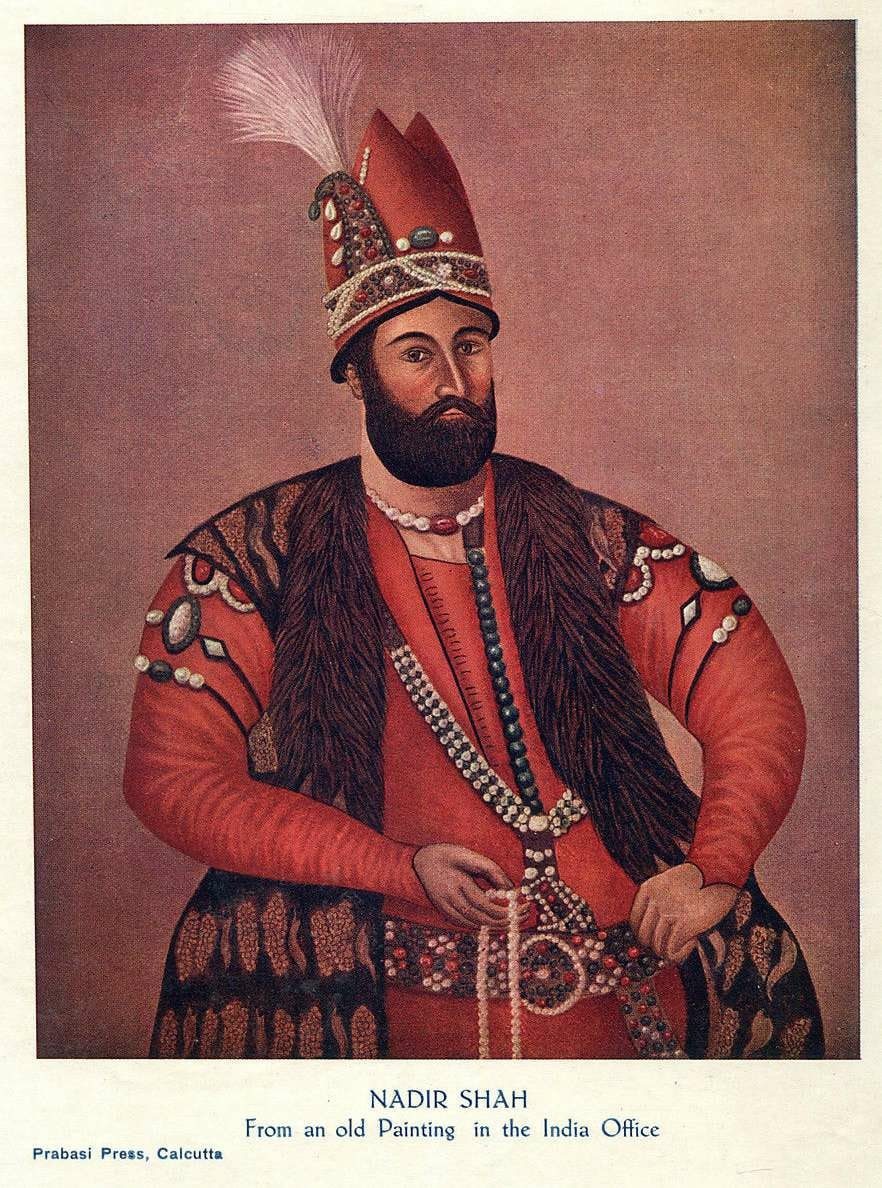
Although the Safavid dynasty lost power in 1736, the Qizilbash rule in Iran continued. The Turks (nomads) received a new lease on life in the person of Nadir Shah. Although Nadir was from the clan of Avshars, he was not considered nobility; as a child he was taken captive by the Uzbeks, and later, for his personal abilities, he headed the Safavid armies in the service of the last Safavid Shah, Shah Tahmasp II, and took on the title of Tahmasp Qoli Khan. Practically the entire state was in the hands of Nadir Khan at that time. Since he was not a nobleman and did not belong to the Safavid family, Nadir-Khan did not declare himself shah for some time, and then, having convened a congress in Sugovushan, on the Mil-Mugan Plain, in 1736, he elected himself shah. Nadir Shah resorted to the ancient Turkic-Mongolian tradition for legitimacy. And after that Nadir Shah continued to boast of his Turkmen roots. He called the whole of Iran the inheritance of the Turkmen tribe. In his letter to the Ottoman vizier, he tried to prevent a war with the Ottomans by reminding them that the Ottomans, like himself, were descendants of Oghuz Khan. When he conquered Delhi, he chose to speak Turkic to the Mughal ruler Muhammad Shah without an interpreter, pointing out that the Mughals were also Turks, and agreed that the Indian dominions would remain under Mughal rule. Agha Mohammad Shah Qajar, who came to power later, like Nadir Shah, also claimed to be descended from the Qajar noion, one of Genghis Khan’s noions, and again tried to secure his legitimacy through his Central Asian Turkic-Mongol nomadic heritage.
After that, however, the superiority of the nomads begins to weaken. After the Russo-Qajar wars, the Qajars, who had lost their Caucasian domains, asked the Europeans for help in carrying out state reforms and re-strengthening the state.
Following almost everything the Europeans said, the Qajars first become acquainted with Orientalism. They learn the term “Persian” from the Europeans, they read what the latter wrote about ancient Iranian kings, and gradually begin to seek their legitimacy in those ancient Iranian kings. For example, Nasir al-Din Shah saw himself as a successor of the Sassanid Shahs.

Nadir Shah’s letter
Admittedly, the Qajars did not completely forget that they themselves were Turks and always used the Turkic language, but gradually the Iranian history, the Sassanid tradition, began to surpass the Turkic-Mongolian narrative. Again, let us not jump to conclusions. For the Qajars, the ancient Iranian Shahs did not mean Tajiks. They still did not identify themselves with the sedentary Tajiks. The Tajiks themselves had no idea that the ancient Iranian kings were actually their ancestors. That is, even though the Qajars were under the influence of Orientalism, the Turks still held a dominant position in Iran, but the foundations of this position had already been compromised.
A new narrative was already being built on the basis of the ancient Shahs of Iran, and this accelerated with the coming to power of the Pahlavi dynasty. Weakened by the defeat at the hands of the Russians, the Qajars never got the power they wanted. The withering Qajar dynasty was overthrown completely in 1925, and the Pahlavis came to power with the British support. Even this family, which later adopted the name of Pahlavi, lacked the legitimacy to take the throne of Iran because the ruling class, however weak its position, had to be Qizilbash in terms of legitimacy. The Pahlavis were not Qizilbash, though they were a Turkic mix, and they could not base their legitimacy on a Turkic-Mongol narrative. The Pahlavi’s rise to power resulted in the Iranian national identity being built entirely on historical Orientalism. In this matter the Pahlavis were advised mainly by the British. The Pahlavis built their new Iranian identity on the “Persian” Farsism. Admittedly, Reza Shah did not want the Europeans to call Iran Persia, and he even sent a note to England. His goal was to build the history of the Iranian state, which began with the ancient Iranian kings and continued with the Pahlavi dynasty, on the basis of the Persian language and identity. Naturally, since Turks were the biggest issue in this narrative, their identity was also interpreted on the basis of this narrative and Turks were presented as Turkified Iranians. The narrative that the present-day Iranian state is based solely on the Persian-Tajik tradition, that the Turks never ruled Iran, the claim that the Iranian state has a 2500-year tradition of continuous statehood, begins with the Pahlavis and is the result of the last hundred years. Thus, the Pahlavis began the process of completely erasing the history of the Turkic nomadic rule in Iran, which lasted for about nine centuries, and brought to the fore the narrative of a purely sedentary people.
Azerbaijan as an heir to nomadic culture
In the modern era, the Turkic-Tajik confrontation entered a new phase. It is no longer a rivalry between two different social groups living in the same state, but a conflict between two states organized in two different territories and claiming the same history from different starting points. Whether we like it or not, even if it is not officially announced, the Republic of Azerbaijan is a continuation of the nomadic Turkic tradition and an heir to this historical legacy. The Islamic Republic of Iran is a continuation of the sedentary Tajik tradition and an heir to its legacy. It is clear that both countries have similar historical claims, as we have spent the last thousand years of our history together. However, the starting points of these claims are different. While Azerbaijan claims this history as a successor to the nomadic Turks who ruled Iran, Iran claims the same history based on geography and historical orientalism. Let me remind you again that the historical narrative in modern Iran was created first by the British (Orientalism) and then for some time by the Germans (with “Aryan” racial tales). Iran is still unable or unwilling to move from the “you are Aryans, you are suns, you are lions” scam that the National Socialists imposed on the Tajiks for geopolitical purposes.
The fact that Westerners refer to Iran as “Persia” and build Iran’s historical narrative on this foundation is consistent with the historical claims of the Islamic Republic of Iran today. Although Azerbaijan tries its best to maintain good relations with Iran, the diplomatic tensions we often experience with Iran have deeper, more fundamental causes. The political differences that cause discussion and debate today are merely a modern reflection of this historical rivalry. The rivalry between Azerbaijan and Iran, that is, between Turks and Tajiks, is a rivalry of civilizations, and the end of this rivalry does not seem possible, at least in our time. Nor is the purpose of this article to urge Azerbaijan to start an open war with Iran or to encourage territorial claims against Iran. It is simply an attempt to look at the rivalry between us and Iran from a historical perspective, and to understand it in the light of history. In dealing with Iran, we must build our historical narrative on a healthy foundation, abandon the current mixed, sloppy historical narrative, and present our own historical theory against Iran and Orientalism. We will certainly reap the political results of this as soft power.
Sources:
Shaffer, Brenda. “Iran Is More Than Persia: Ethnic Politics in the Islamic Republic.” FDD, 28 Apr. 2021, https://www.fdd.org/analysis/2021/04/28/iran-is-more-than-persia/.
Peacock, A.C.S. Early Seljuq History: A New Interpretation. Routledge, 2013.
Basan, O. A. (2010). The Great Seljuqs: A history. Taylor & Francis.
Hambly, Gavin R.G., Allworth, Edward, Sinor, Denis and Smith, David Roger. “history of Central Asia”. Encyclopedia Britannica, 15 Nov. 2021, https://www.britannica.com/topic/history-of-Central-Asia-102306. Accessed 20 April 2022.
Vásáry, István. “The Role and Function of Mongolian and Turkic in Ilkhanid Iran.” Turcologica 105. Turks and Iranians. Interactions in Language and History, 2016.
Fragner, Bert G. “Central Asian Aspects of Pre‐Modern Iranian History (14th to 19th Century).” Central Asian Survey, vol. 12, no. 4, 1993, pp. 465–471., https://doi.org/10.1080/02634939308400832.
Woods, John E. The Aqquyunlu Clan, Confederation, Empire. University of Utah Press, 1999.
Yazıcıoğlu, Ali. Târîh-i Âl-i Selçuk. Topkapı Sarayı, 1436.
Della Valle, Pietro. The Travels in Persia.
Related Posts


Previous Post
Next Post


- Aliyev says Turkic world is emerging as a major center of influence

- Baku hosts Turkic World Week honouring landmark 1926 Turkological Congress

- EU envoy holds talks in Baku ahead of high-level engagement with South Caucasus

- Europe must not lose Azerbaijan: Oleksiy Goncharenko on the risks of confrontation between Baku and the Council of Europe

- A leader forged by patience and victory
