Search results for "Turkic Council"9- Page

Logistics-Transport25 December 2021

Following the Protocols signed in 2009 to normalise relations between Turkey and Armenia, Turkey took the initiative as of 2010 to implement a holistic cooperative project, which aimed at supporting regional ties in the South Caucasus through economic-commercial means reacting effects on a regional as well as global scale.

Opinion30 August 2021

This paper covers the South Caucasus policy of Turkey after the 44-Day War be- tween Azerbaijan and Armenia in 2020. The aim of the research is to investigate the role of Turkey, which supported Azerbaijan politically and morally in the war, in the South Caucasus. This article concludes that, after this war, a new geopolitical situation has emerged in the South Caucasus region. In this new geopolitics, Turkish soldiers have been deployed, alongside those from Russia, in the Joint Monitoring Centre to observe the ceasefire in the Karabakh region of the Republic of Azerbaijan, and Turkey became a kind of guarantor of the liberated Azerbaijani territories through the Shusha Declaration signed between Turkey and Azerbaijan. Additionally, according to the trilateral statement of Azerbaijan, Armenia, and Russia that was signed on 11 January, it was decided to establish a new corridor that is planned to pass through Armenia to connect Turkey with Azerbaijan. Moreover, Turkey–Azerbaijan strategic relations have entered a new phase in terms of economic, military, and defence industry technologies. In short, after the 44-Day War, Turkey gained an advantageous position in the South Caucasus and Central Asia.

News18 June 2021

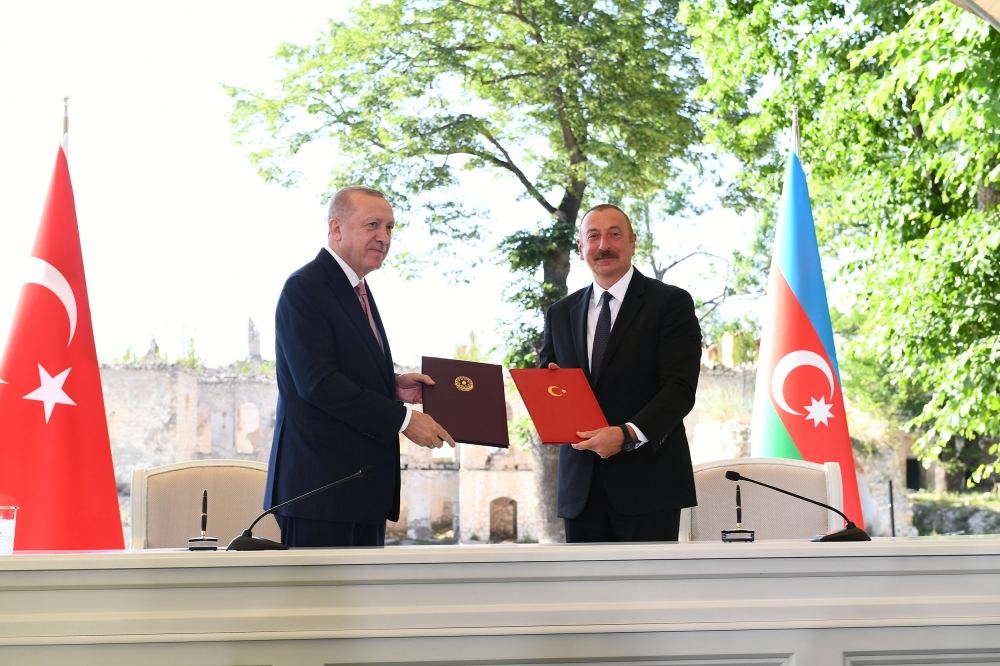
The full text of the Shusha Declaration on Allied Relations, which was signed June 15 by Azerbaijani President Ilham Aliyev and Turkish President Recep Tayyip Erdogan in the city of Shusha, has been published.

History13 June 2021

According to the data of Narkhozuchet (the national economic accounting agency) and the Ministry of Agriculture of the Armenian SSR, 25,000 Azerbaijani families, or about 110,000 people, lived in Armenia before the resettlement in 1948. Of these, only 9,000 families, or 35,000 people lived in lowland regions, the remaining 75,000 inhabiting mountainous regions of the Armenian SSR.

Gender25 April 2021

However, in the early years, women still could not fully comprehend the significance of the rights they had gained, and the relics of feudal patriarchal way of life hindered the handling of women's issues in Azerbaijan. Therefore, the issuance of decrees, resolutions and regulations and the adoption of laws did not mean actual gender equality.

Opinion23 April 2021

Azerbaijanis are the second largest ethnic group in Georgia. Most of the Georgian Azerbaijanis live in the region of Kvemo Kartli (the municipalities of Marneuli, Bolnisi, Dmanisi and Gardabani), and in a small part in Kakheti and Shida Kartli. Azerbaijanis make up 84% of the population in Marneuli, 66% in Dmanisi, and 63% in Bolnisi, and 44% in Gardabani. According to official statistics for 2014, the total of 233,024 Azerbaijanis live in Georgia. 75% of them are Sunni Muslims and 25% are Shiites.

Opinion20 April 2021

In June, Azerbaijan announced that it was planning to buy Turkish-made armed drones. “Efforts in this direction are continuing. Now we are having results,” said Azerbaijan’s Defense Minister Zakir Hasanov. In the same month, the Azeri parliament approved a bill to receive financial assistance from Turkey to be used for the purchase of weapons systems.

Menu Search Dark Mode Light Mode
Loading

Signing-in 3 seconds...

Signing-up 3 seconds...